|
Japan & Basenji |
| Here I am, back home from a
journey I did not have in mind to do in this life: six days in Japan.
We
knew from the beginning that the free time at our disposal would have
been short, but when we could have another similar occasion, such a
great invite? A lot of hours spent on the plane and we found ourselves
in the same Italian weather, a bit more humid, sun light at 4:30 and
dark pretty soon. Even when the weather is nice, in Tokyo the sky is
always covered by the smog. Most of our days are organized and full of
appointments and established engagements. First stop the Pacific Flora
in Hamamatsu, a flower and furnish fair that last six months, where my
husband’s company has planned a Tuscany Garden, then the last two days
in Tokyo… We are amazed by the Japanese’s passion for all that is Italian, by their education, the strong tidy and silent influx of people at any exhibition, the relative few technology, the high price of fruits, the not so expensive price of life as long time ago for us European, thanks to the birth of the Euro, and the almost total absence of information translated in English, everywhere. We
try to have a confirmation of the news that a couple of basenjis have
been given as a gift to the Emperor but nobody knows anything about it.
In reality every one is really gentle but nobody knows the basenji’s
breed. Only in Tokyo we succeed in having a free half day and we are accompanied at the National Museum (http://www.tnm.jp/) to see paintings, statues, clothes and old Japanese swords: on the territory we have passed with the coach, the car or the super-fast train everything is new or rebuilt, there are no real traces of an ancient past like here in Italy. We
enter inside the first building of the Tokyo National Museum: Honkan,
inaugurated in 1928. We found ourselves immersed in another, different
world, the rooms are a lot and crowded, there is also somebody who prays
in front of statues of ancient divinities. We spy quickly on the section
about the prehistoric finds, the time at our disposal is limited and we
cannot see everything. I am amazed to consider a diverse aspect: Japan
for us is ancient printings on rice paper, swords and samurai, kimonos;
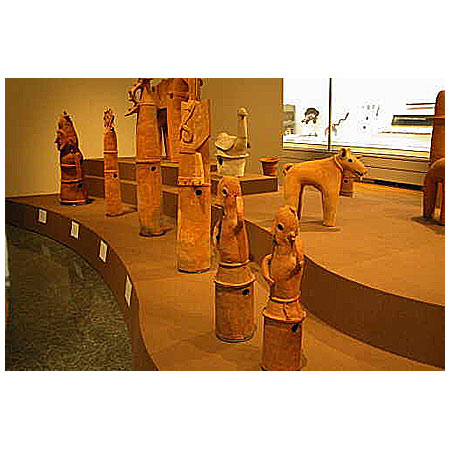
it is difficult to think at their origins. Suddenly I bump into a series
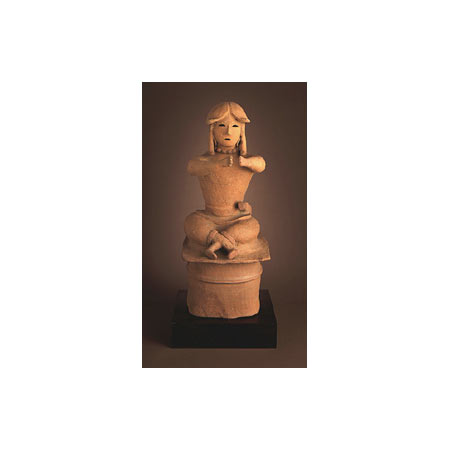
of terracotta artefacts: houses, warriors, animals, they are very simple,
smooth and stylized. A part of the collection is closed but what we see
leave me with a sense of inquietude, like when you find something arcane
and not at all explicable. Only at the end of our visit I will
understand why. The
time at our disposal is ending, a fast dash into the shop of the museum
to buy something and we will go back in the grip of the programmed
encounters of this trip… But suddenly, I am attracted by
a terracotta shape familiar to me. I look at it, I look again, it is not
possible, it cannot be here. I search for some explanations in English
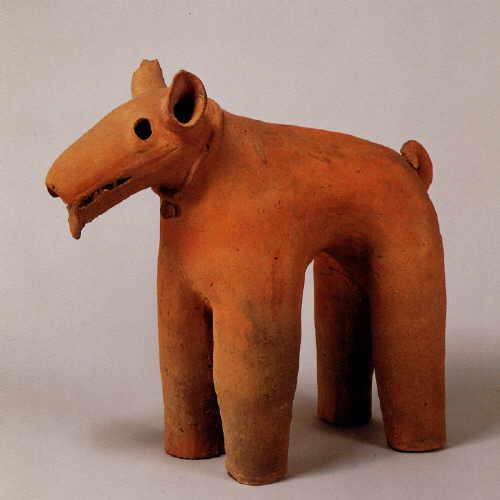
in order to understand, to have a confirmation… HANIWA: terracotta Dog; Kofun Period: 300 a. C.- 552 a. C. I read more than once before my voice and my brain can meet and I call Francesco unbelieving. He is of the same opinion of me: we found a Basenji, a copy of a prehistoric find, here, on the other side of the world.
It
is the copy of a little statue of a dog with pointed ears, of a squared
shape, stocky but elegant and smooth. It has a little curly tail, a slit
mouth with the tongue outside and a little bell around the neck with a
string. Why is it here? I cannot understand a lot from the little
information in English present there, only after our return in Italy,
through the Internet, I am able to disclose part of the mystery. At the downing… The
first Japanese settlers, during the Neolithic, were the Jomon (about
10000 b.C-300b.C.). They realized little statues called dogu,
mainly representing female figures. Lately,
between the Copper Age and the Bronze Age, lived the Yayoi (about
300-b.C.-300 a.C.), the nucleus of whom, at the beginning of the period,
was represented by a different group of immigrants, who created copper
weapons, bronze belts and potteries cocked in the ovens. Typical
artefacts of the following period, the Kofun (Mounds’ period,
about 300-710), during the Bronze and Iron Ages, were bronze mirrors and
clay sculptures called haniwa, that were erected outside the tombs.
Simple figures with a stick’s shape on belts (dotaku), produced in the
Yayoi period, and paintings that decorated the internal walls of the tombs
in the Kofun period, represent the origins of the Japanese painting. This
period ends with the arrival of the Buddhism and of the different
practices of burial linked to it.
The Haniwa were placed above the mounds, the nobles’ tombs, built like hills in dominant areas. The terracotta artefacts were ornaments and were supposed to be well viewable at a long distance. The manufacturing was different but all pretty fast,
there were potteries of different colours or even painted but the tomb in
general was supposed to be prepared as quickly as possible.
Particular
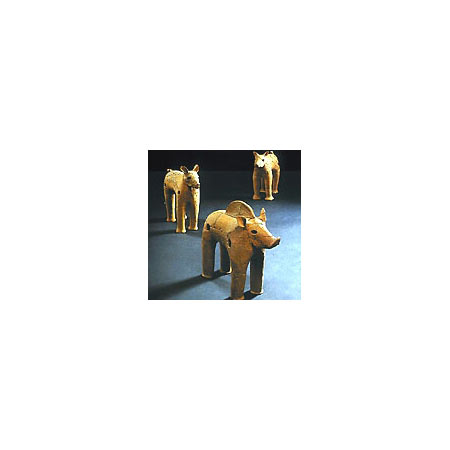
Haniwas like birds, cows, horses and dogs were grouped and their place
was no established. Probably, for the continuous changing of place in
time, everything has a ritual value and a ceremonial use.
I do not know exactly what was the dawning of the migrations or the exact origins of the human beings and their contemporary animals, but it is sure that this is the umpteenth proof that the Basenji, in this culture too, was a magic creature that silently, even here, left his scent.
Thanks for translation to Laura, the owner of Lali |
|
22 May 2004 |